
In the professional services sector, relationships are your most valuable currency. However, the landscape has shifted. We are now operating in an era of extreme Time Poverty.
For the modern corporate professional, the decision to attend an event is a high-stakes trade-off.
The modern attendee no longer attends just to “network” or “be informed”; they attend to feel seen, understood, and catered to. They demand a tailored experience to justify the time spent away from their desks and families. If your event feels generic, it isn’t just a logistical oversight—it’s a Brand Risk.
Let’s be honest: a name on a badge or a mail-merge invite is no longer a strategy—it’s the bare minimum. Every touchpoint in a corporate event acts as a live demonstration of your firm’s competence.
At MB Squared, we know that true personalisation requires more than just data; it requires disciplined Event Strategy and Consulting. We don’t just plan for connection; we calculate it.
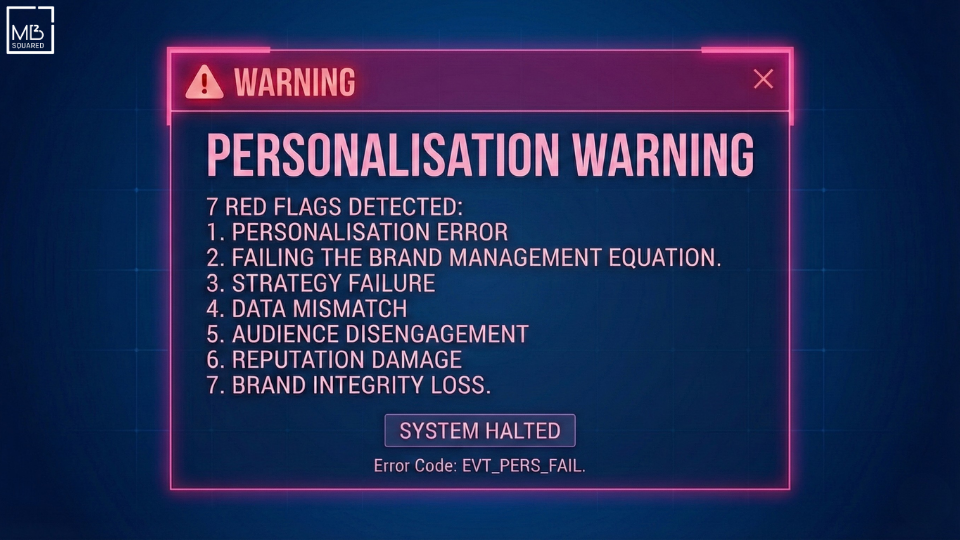
Is your event failing the equation? Here are the 7 red flags that your strategy is costing you business.
1. The "Generic Experience" Penalty (The Time Justification Gap)

The biggest red flag in 2026 is an event that feels “one-size-fits-all.” Your attendees are asking: “Is this worth my time?”
If they arrive to find a generic agenda and blanket content, the answer is a resounding “No.” True personalisation is the only way to bridge the Time Justification Gap. When an experience is tailored to an individual’s specific challenges or professional goals, the “cost” of their time is offset by the value of the experience.
Time is the scarcest resource and unless it is managed nothing else can be managed.”
2. The "Bare Minimum" Variable
If your personalisation begins and ends with a name badge or an automated “Hello [First_Name]” email, you are failing the first variable of the equation.
In professional services, the Loyalty Multiplier only triggers when an attendee feels seen as a valuable individual, not a row on a spreadsheet. In an era of hyper-service, the “bare minimum” signals to your high-value stakeholders that you are efficient, but not empathetic.
3. The Sensory Disconnect (Misaligned Brand Promises)
A major red flag is a sensory disconnect between what your firm says and what the attendee experiences.
- If your firm claims to value innovation but uses static agendas and 100-slide decks, you have created a negative brand narrative.
If you value Corporate Well-being but serve heavy, energy-draining meals during a high-focus strategy session, you have broken a brand promise.
4. The "Broadcasting" Trap
Internal marketing teams often focus on what the firm wants to say, rather than what the attendee needs to experience.
A successful equation calculates the Return on Relationship (ROR) by shifting the perspective. True personalisation means empowering the attendee to curate their own journey within your event framework. If your agenda is a one-way street, you aren’t personalising; you’re just presenting.
5. The Clinical Tech Gap
Using AI or event technology without human oversight is a dangerous trap. While algorithms are essential for automating logistics, they cannot manufacture chemistry.
If your event feels “clinical” or sterile, your technology-to-human ratio is out of balance. This is the Uncanny Valley of events—where the tech is smart but the atmosphere is cold. Human engineering is required to add the emotional intelligence that software lacks.
6. The Failure of "Anticipatory Service"

A standard strategy puts a coffee cart in the corner and calls it a day. Strategic execution moves toward the Anticipatory Service Standard.
This means your team is empowered with the data insights to know the preferences, professional backgrounds, and specific needs of your key stakeholders before they even ask. This tactile layer of the equation proves you have invested the resources into knowing them personally.
7. The "Hanging" Close (The Missing Specialist)
The biggest red flag? Thinking you can solve this complex equation with a generalist team.
Failure to implement advanced, data-driven personalisation is a strategic communication failure. The equation involves advanced data auditing, psychological profiling, and flawless production management.
You now know the variables. But do you have the engineer?
Strategic FAQs: The Professional Services Perspective
Why is “Time Justification” so important now? Because your attendees are busier than ever. Personalisation is the “rent” you pay for their attention. If an event doesn’t feel tailored to their specific professional needs, they will simply stop attending.
How do I spot the “Bare Minimum” trap? If your team spends more time on the font of the name badges than on the “Anticipatory Service” plan for your top 50 clients, you are prioritising decoration over relationship engineering.
What is the risk of the “Clinical Tech Gap”? It alienates senior stakeholders. High-net-worth clients value human connection. If your event feels like it’s being run by an algorithm, you lose the warmth and trust essential for long-term loyalty.
What is the “Anticipatory Service” standard? It’s the shift from reactive service to proactive hospitality. By using smart data intelligence, we ensure your stakeholders feel known without the need for invasive or overly expensive tech. It’s about being prepared, not just present.